
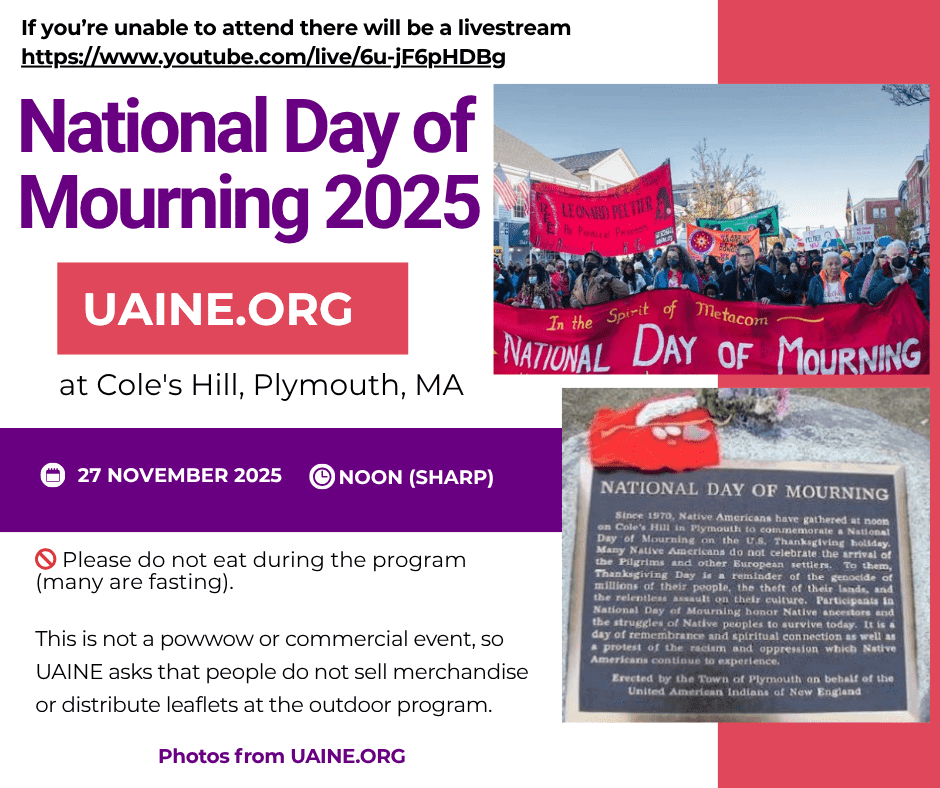
There’s a march in Plymouth, MA on Thursday at Noon SHARP
- Flyer for the March on Thursday, November 27, 2025 at Noon
- Orientation and Important information for the March on Thursday, November 27, 2025
Here’s a social media post you can share. I left off the UAINE seal so there’s no confusion about it being an official image from them.
Businesses and families across the United States are preparing for Thanksgiving. Usually, people associate this time with turkey, football, and a story about Pilgrims and Native Americans sharing a peaceful meal.
However, for Indigenous people, and for me personally, the fourth Thursday in November holds a very different meaning.
The Spirit Behind “Machi”
If you have ever wondered about my business name, here is the story. “Machi“ refers to the traditional healers and shamans of the Mapuche people of Chile.
Although I have Indigenous roots in South America, a white family adopted me as a baby. Consequently, I grew up in the United States without my culture or the stories of my ancestors. Yet, that identity lives in my heart. I am actively working to learn about and reclaim it.
For this reason, my heritage guided my business colors and my name. In fact, traditional Mapuche woven textiles inspired my logo design. I created it this way to serve as a constant reminder of my people’s struggles.
Running a business is hard. But surviving genocide and colonization is harder. When I look at my branding, I remember that my people are still fighting. Therefore, that memory instills in me the determination to push through hard times. I want to embody the spirit of my ancestors to find strength. To me, that means I have a responsibility to support Indigenous people who are fighting for their rights today.
The Prophecy of the Eagle and the Condor
You might wonder why a Mapuche woman is writing about a protest in Plymouth, Massachusetts.
Specifically, there is a prophecy shared by many Indigenous peoples across South and Latin America known as The Eagle and the Condor. The Eagle represents the peoples of the North (North America). In contrast, the Condor represents the peoples of the South (South America).
The prophecy predicts a time when the Eagle and the Condor will fly together again. Ultimately, this reunion will unite the people of the Americas and bring the world back into balance.
My ancestors are from Wallmapu (Mapuche territory). The people gathering in Plymouth are from Turtle Island (North America). Nevertheless, our stories are hauntingly similar. We have both faced the erasure of our languages, the theft of our lands, and the violence of colonization.
I may not be North American Indigenous. However, I recognize that colonizers drew the borders that separate us. The struggle for dignity is shared. Thus, by standing with the National Day of Mourning, I am doing my small part to help the Condor fly with the Eagle.
Family, Food, and The Truth
I learned the gravity and the lies surrounding the “Thanksgiving” mythology very early on. The dark history of colonization wasn’t a mystery to me for long.
Even so, this Thursday in November has always held a complicated importance in my life. Growing up, it was the one day of the year where my entire family would come together. Indeed, not even Christmas could pull us all into the same room the way Thanksgiving did.
For my family, the day was never about the Pilgrims. We didn’t acknowledge the Mayflower or the false narrative of “peaceful coexistence.” Instead, we acknowledged each other. It was about the reunion, the laughter, and the delicious food shared with the people who raised me.
But I have to hold two truths in my hands at once.
I can deeply love the time spent with my family and cherish the safety of that gathering. Simultaneously, I can reject the national holiday labeled “Thanksgiving.” I can pass the potatoes to my loved ones while my spirit stands in solidarity with the Indigenous people gathering at Cole’s Hill.
I do not recognize the holiday. I recognize the family. And I recognize the truth.
What is the National Day of Mourning?
Since 1970, Indigenous people and their allies have gathered at Cole’s Hill in Plymouth, Massachusetts. They gather not to celebrate, but to mourn.
The tradition began when state officials invited Wamsutta Frank James, an Aquinnah Wampanoag leader, to speak at a banquet. However, organizers censored him when they saw his speech. He wanted to speak the truth about the Pilgrim arrival. As a result, he refused to be silenced, and the National Day of Mourning was born. It is a day to remember the genocide of millions of Native people, the theft of Native lands, and the relentless assault on Native culture.
Join Me in Observation
You do not have to be Indigenous to recognize the National Day of Mourning. If you would like to join me in observing this day on Thursday, November 27, 2025, here are three ways to help:
- Watch the Livestream: If you cannot be in Plymouth, you can watch the speakers and the rally live starting at 12:00 PM ET. Watch Here.
- Donate: Support the United American Indians of New England (UAINE) to help fund their ongoing advocacy. Donate Here.
- Reflect: If you are gathering with family, take a moment to acknowledge the land you are on and the true history of this continent.
At Machi Marketing, our values are woven into the fabric of our brand. Today, and every day, I honor the resilience of my Mapuche ancestors and my Indigenous relatives across the Americas.
Places to Learn More
North American Indian Center of Boston
United American Indians of New England
Wampanoag Tribe of Gay Head (Aquinnah)
Chappaquiddick Wampanoag Tribe
SmokeSygnals – A Wampanoag-owned media production company.
The Native Land Conservancy – The first Native-run land conservation group east of the Mississippi River.
The Wôpanâak Language Reclamation Project – A language revitalization program.


Leave a Reply